The market is bolting AI on top of dashboards. Auto-generated insights, contextual actions, role-adaptive interfaces. Before accepting that as the answer, it's worth asking what the dashboard was actually doing.
Three functions, usually conflated
Visual Q&A. The interactive surface for asking questions of the data.
Artifact of agreement. The dashboard's number was the number because the organization had agreed it was canonical — not because it was technically superior.
Governance ritual. As a fixed, shared object, the dashboard forced collective conversations around the same screen when something diverged.
Generative AI collapses the cost of the first function to zero. The other two — where the institutional value actually lives — it dissolves. Any replacement that solves only Q&A is killing two functions to fix one.
The two dominant approaches both miss
Chatbots on semantic models (Power BI, Tableau). The AI sits on top of the dashboard's front-end with no access to the underlying facts — it reads outputs, not data. The newer variant that lets the LLM generate SQL freely against the warehouse goes the other way: it answers questions the dashboard couldn't, at the cost of dissolving the shared anchor. Five users formulate the same intention with slightly different words, get formally correct but semantically divergent SQL, and circulate the numbers as if they were comparable.
Integrated platforms (Microsoft Fabric, Databricks). The opposite move: pull the business context inside the data platform itself. The technical catalogs — Unity Catalog, BigLake, Polaris — have legitimately solved unifying metadata about data. What's still contested is whether the warehouse should host the legislation over processes. Locking hot rules inside a system optimized for cold data charges a tax every time a rule changes.
The enterprise software industry already ran this experiment, fifty years ago, under the name "the universal ERP." SAP needs six to eighteen months of consulting per implementation, and an ecosystem of vertical SaaS — Salesforce, Workday, NetSuite, ServiceNow — emerged because each specialist beat the monolith on its own turf. The universal warehouse promise is structurally analogous.
The flip: foundations vs products
Separate the permanent investment from the consumable. Foundations are the infrastructure that survives any product built on top. Products are what the business consumes — they should be replaceable when the technology context shifts.
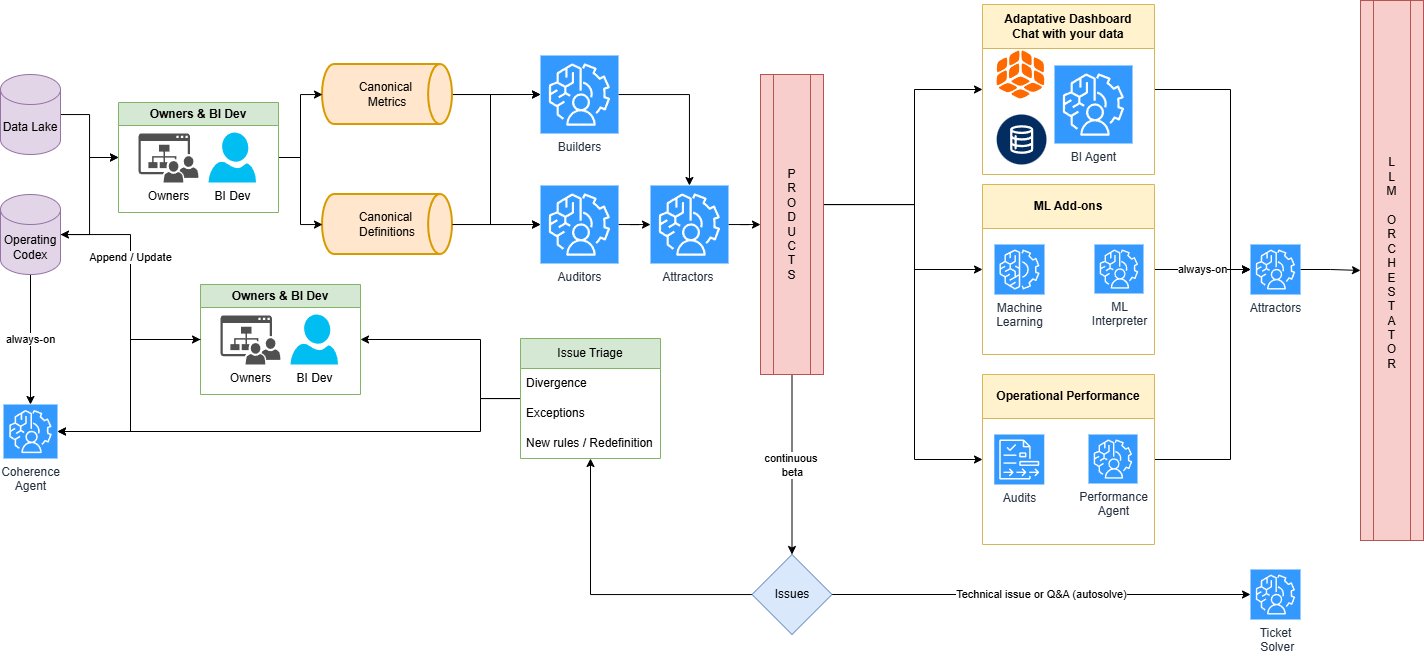
Foundations on the left (Operating Codex, canonical metrics and definitions, owners and BI dev) feed agents in the middle (Builders, Auditors, Attractors, Coherence Agent), which serve the products on the right. Usage flows back via continuous beta through an issues classifier that routes architectural decisions to human triage and technical incidents to an autonomous solver.
Reading the diagram
The Codex. Operational documentation as navigable text, sitting parallel to the warehouse — not inside it. Holds canonical metrics (numbers) and canonical definitions (meaning) as two distinct artifacts. Updates at operational cadence, not on deploy windows.
Four agents, each on its own clock. Attractors pull semantically equivalent queries toward the same canonical answer, containing LLM variance. Builders translate canonical intent into executable code. Auditors verify outputs reproduce canonical metrics. Coherence agents continuously scan the Codex for internal contradictions.
Humans in two waves. Bootstrap formalizes initial definitions; continuous maintenance handles what emerges from use. Same professional role, two cadences.
Feedback loop. Usage flags, auditor flags, and coherence alerts feed a classifier. Architectural issues — divergence, exceptions, new rules — route to human triage. Technical issues and Q&A route to an autonomous solver. Analysts only see what genuinely requires their criterion.
What this changes operationally
Audit and versioning. Every rule change recorded with author, effective date, and rationale. Reproducing past values stops requiring archaeology.
Propagation across products. Change a KPI definition once; every dashboard, report, and downstream model reflects it.
Continuous self-correction. Coherence agents surface contradictions before operational queries expose them.
Operational separation between architectural and technical load. Analysts focus on what changes the architecture, not on routine incidents. This is what lets the proposal scale without multiplying analytical headcount.
Accountability preserved by construction. Every flag elevates to a named human. The system accelerates but doesn't dictate.
Closing
The proposal isn't to replace the dashboard. It's to distribute the three functions it served — Q&A, agreement, governance — across products that share foundations. The dashboard keeps existing, but it stops being the only container of operational truth.
The change isn't about interface. It's about where the investment sits: in shared foundations, not in individual products that get rewritten every time the technology context shifts.